

The Greatest Untapped Resource on This Planet. And Why They Don't Want Us in the Same Room
Updated: May 11
I say it in every room I walk into.
“The greatest untapped resource we have on this planet is the unrealised potential of women.”
I said it again this week, sitting across from two senior men in an organisation, with James beside me. I said it the way I always say it - not as a provocation, not as a pitch, but as the thing I know to be true in my bones.
And they agreed with me.
I don’t take that for granted. I really don’t. Not right now.
Here’s what I get to witness.
I get to see women walk into a space already apologising for being there, and walk out knowing they never needed to apologise at all.
I get to see the moment a woman realises that the voice telling her she’s too much, not enough, too loud, too sensitive, isn’t hers. It was installed. And it can be uninstalled.
I get to sit in rooms with some of the most extraordinary women walking this planet and watch them sprinkle love on each other like it’s the most natural thing in the world.
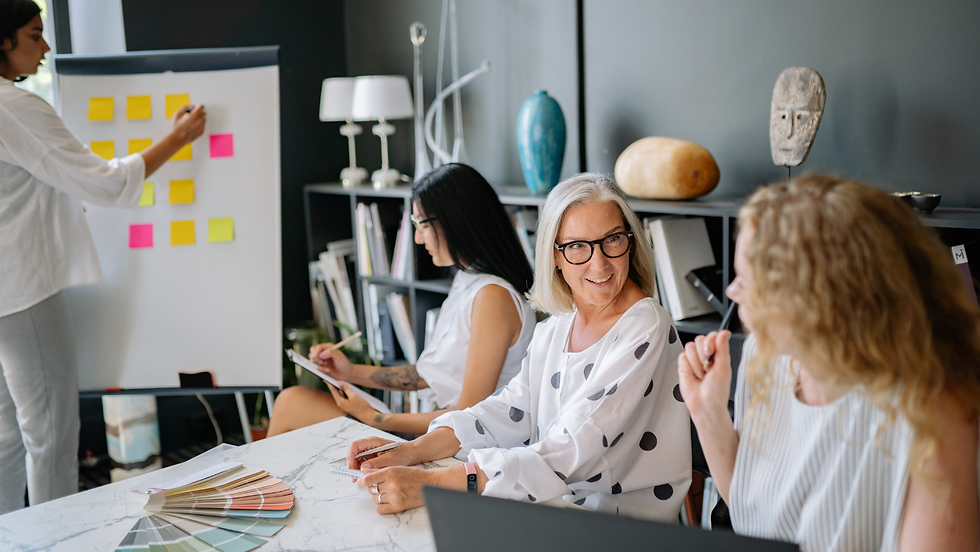
And I get to watch what happens when women are simply together.
Not performing. Not competing. Not managing how they’re perceived. Just together, in a room, talking honestly about their struggles and their wins and the gap between who they’ve been told to be and who they actually are.
I know that not every woman arrives feeling safe about that. This week, I heard from women on my own programme who had come in apprehensive, because they’d been burned before. By women’s spaces that turned out to be just another arena for competition and comparison. By communities that promised sisterhood and delivered something that felt more like a different kind of performance.
I get it. That experience is real, and it’s more common than it should be.
But I also know that apprehension is itself a symptom of conditioning. When women have been pitted against each other long enough, rewarded for outdoing one another, penalised for collaborating, distrust becomes the rational response.
It’s not a character flaw. It’s what happens when you’ve learned that other women are competition rather than sisterhood.
And watching those same women (the ones who arrived with their guard up) soften into the space? Realise they were safe? Start to let each other in?
It is, without exception, one of the most powerful things I have ever witnessed.
Which is why I pay attention when certain people, powerful people, people with entire governments behind them, start to get twitchy about women gathering.
You may have seen the headlines about the US government suing a company for discrimination against men for holding a women-only networking event. (I did a post about it on LinkedIn this week.)
When the mere act of women meeting together - networking, supporting each other, being in the same room - starts to get framed as dangerous, as discriminatory, as something that needs to be stopped?
That tells you everything about what they’re afraid of.
Women in community are not a threat to equity.
Women in community are equity. In action. In real time.
And let’s just pause here for a moment.
If women were naturally meant to be subordinate and submissive, if that were simply our nature, our destiny, the way things are supposed to be, why has it taken quite so much work to get us there?
If you think about it. The millennia of laws. The institutions that were built to keep us dependent. The religions that wrote us into footnotes. The education systems that taught us to defer. The medical establishment still calling our distress hysteria. The beauty industry monetising our self-criticism (and the fact that beauty standards revolve around teenage girls! Gross 🤢). The workplaces that rewarded our compliance and punished our ambition.
The language that made “bossy” an insult and “difficult” a threat.
That is not the architecture of something natural.
That is the architecture of something that has to be constantly, exhaustingly, and expensively enforced.
And now, this week, I have seen multiple people online declare (with straight faces) that the greatest threat to civilisation is white liberal women.
I’ll be honest with you. I laughed. And then I thought about it a bit more.
Because if we were really that powerless, that irrelevant, that easily managed, why are we the threat? Why does it keep coming back to us? Why are we, apparently, the thing that keeps certain people up at night?
I think we all know the answer to that.
The greatest untapped resource on this planet is the unrealised potential of women.
And some people have always known it.
They just prefer it to stay untapped.
This is what I know to be true and what I build everything on:
Women are not broken. They are conditioned.
People-pleasing, perfectionism, and silence are not personality traits. They are survival strategies - smart, sensible responses to a world that rewarded them for shrinking.
Self-doubt is not a personal failing. It is a political wound.
And isolation? Isolation is how conditioning stays intact. It is very hard to question the story you’ve been told about yourself when you have no one around you who is questioning it too.
Community is not a nice-to-have. It is not the warm fuzzy bit at the side of the real work.
Community is the work.
Because the moment a woman hears another woman say “me too - I thought it was just me” - something shifts. The shame loses its grip. The story starts to crack. The conditioning, which depends entirely on a woman believing her experience is uniquely, personally, shamefully hers, begins to fall apart.
That’s what happens in the room.
That’s why the room matters.
That’s why I will keep creating the room, keep filling it with extraordinary women, and keep watching them remember who they are.
The greatest untapped resource we have on this planet is the unrealised potential of women.
And the greatest accelerant for that potential is each other.
I’m not stopping until every room agrees. And I’m certainly not stopping because certain people have decided that women meeting is something to be afraid of.
If anything, that just tells me we’re doing exactly the right thing.
Which is why I’m building a home for it.
A proper community. A place where the room never closes.
Where the conversation that starts in a shared book, experience or programme carries on, where women can gather, freely, joyfully, and without anyone deciding that’s a problem, for as long as they want to.
We’re starting with a 12-week read-along of Good Girl Deprogramming. Together. In community. The way it was always meant to be read.
If this is your kind of room - come and find us - https://www.michelleminnikin.com/work-with-michelle/community
Michelle Minnikin is a Chartered Organisational Psychologist, author, and co-founder of The Deprogramming Company.


Comments